
In United States, the airspace is divided between center, terminal area (approach/departure), and tower (class delta airport) controllers. Per regulations, a flight operated under the Visual Flight Rules (VFR) is not required to talk to ATC while within Class E airspace. You must only establish two way radio communication before entering Class D, C, and B airspace (Class B requires a specific clearance to enter as well). That being said, wouldn’t it be great for someone to keep an eye on your airplane while you fly hundreds of miles across United States, in case of an emergency and need of assistance? I think it would be great, and guess what, there is a way, it is called VFR Flight Following.
VFR Flight Following is a service that center and terminal area air traffic controllers provide to those pilots flying under VFR. It is important to remember that this service is provided as workload permitting bases, so, do not be surprised if ATC tells you that he can’t do it. He may be just too busy with all other IFR traffic. In my years of flying, ATC has always accepted my VFR flight following requests quite happily, simply because ATC would want to talk to you if you are in their airspace rather than dealing with an airplane of which they have no clue what will do. There are three stages of VFR flight following. Picking up VFR flight following (on the ground, or in the air), flying to your destination under VFR flight following, and cancelling or getting terminated from VFR flight following by the ATC. Let’s dive in.
Picking Up VFR Flight Following
There are two ways to pick up VFR flight following, on the ground at an airport or in the air. I’ve already covered in detail how to pick up VFR flight following on the ground before departing from a class delta or charlie airports. Read more here: ATC Communications Guide for Student Pilots.
In order to talk about how to pick up VFR flight following in the air, let’s assume you just departed from Taylor Municipal Airport (T74) with the intention to fly to Angelina County Airport (KLFK). First you need to figure out who is controlling the Class E airspace that you are currently in. If you are close to a Class C or B airspace, then the Class E airspace surrounding the Class C or B airspace will be controlled by the terminal area (approach/departure) controllers. If you are in the middle of nowhere, then it will be center controllers.
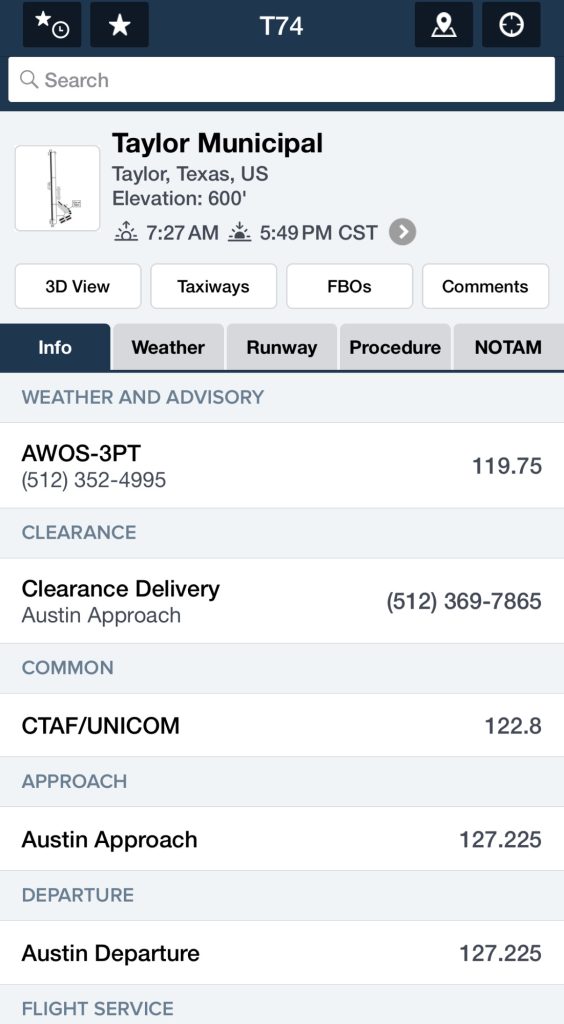
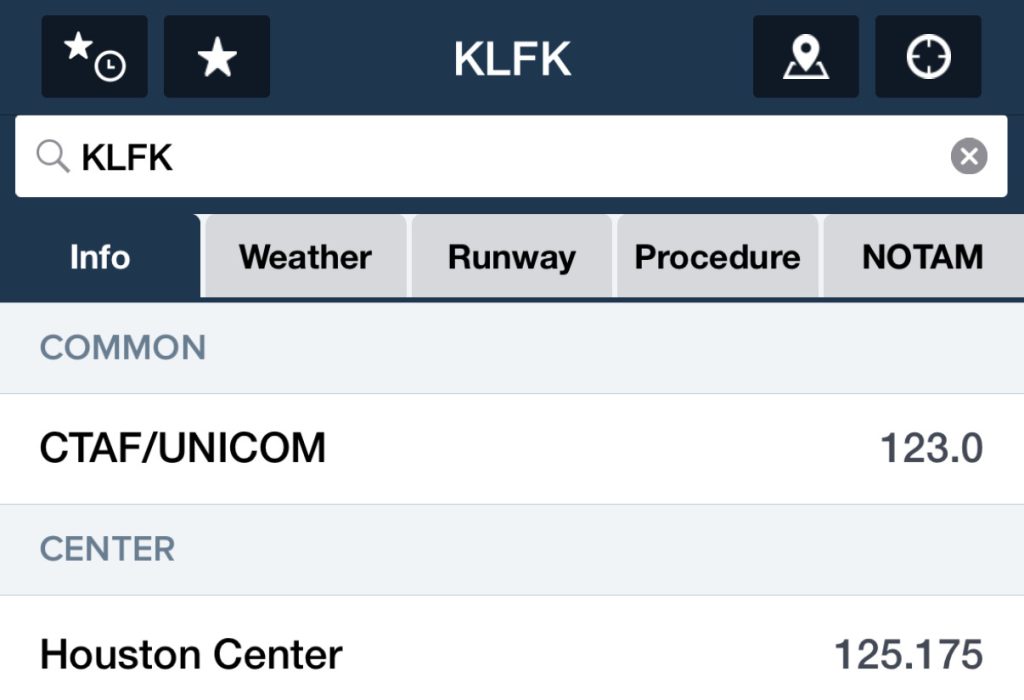
The easiest way to find the terminal area or center controller frequency is to look at the frequencies listed for a public airport that you are closest to. Since we just departed from Taylor Airport, looking at the frequencies for that airport, we can see 127.225 is the frequency for Austin Departure. You may ask why both Departure and Approach has the same frequencies. Depending on how busy the airport is, sometimes two different controllers may work departures and arrivals separately (e.g. Dallas Metro or Houston Area). In this case, only one controller working both departures and arrivals for that sector which the Taylor Airport is located. As we previously discussed, if you are near an airport, far away from any metro areas, then the Class E airspace will be controlled by a center controller. If you look at the frequencies listed for Angelina County Airport (KLFK) below, for example, you can see Houston Center frequency is listed rather than a departure frequency. You can request VFR flight following from either a terminal area controller (approach/departure) or center controller.
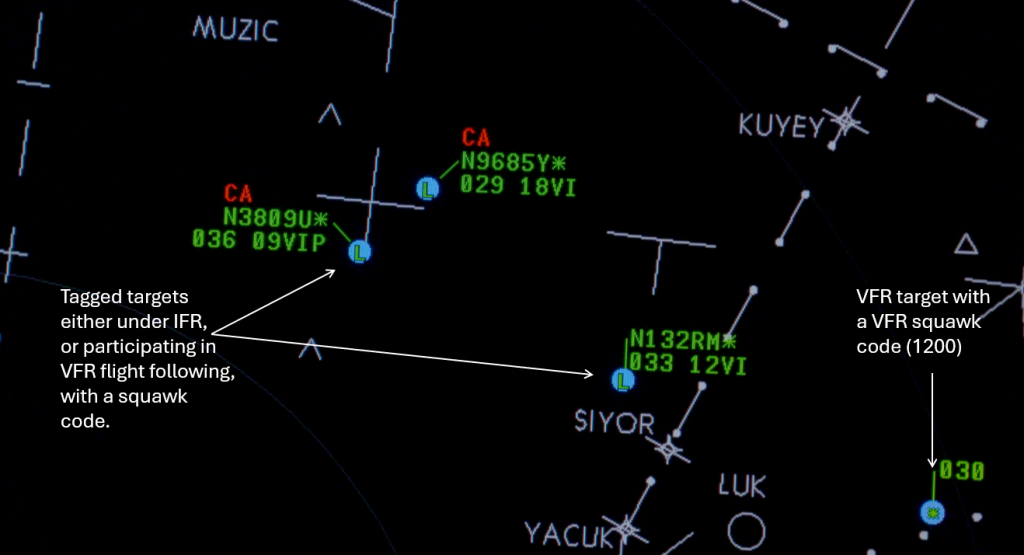
Let’s first try to understand what air traffic controller does when you ask for a flight following request. They must gather some information from you in order to “tag you up” in the system. You have to understand that air traffic controllers see your airplane in their radar screen regardless of you are talking to them or not. If you are not talking to them, in other words, if you are not receiving VFR flight following, your airplane target icon will be displayed without much information. Airplanes that are talking to ATC and under VFR flight following (also flying IFR), will be displayed with additional information (tags) next to the target icon. Why is this important to understand? If you are talking to ATC to get VFR flight following, they will verify your altitude. That way, they can trust the altitude tag displayed next to your target in the radar screen (see example on the left side of the radar screen below). If you are flying around, with 1200 squawk code on your transponder, your airplane will still show up in the radar screen, with a radar estimated altitude (non verified). In this case, ATC will not trust that altitude reporting, not to mention that they would have no idea if you are gonna make a turn, climb, or descend. That’s why they will make sure to keep any airplanes well away from you which makes things harder for everyone.
We now have a better understanding of what the air traffic controller sees. As we said before, you must provide some information to the controller to get VFR flight following. There is an order of which the controller wants to hear that information simply because that is the order which they will have to type it in the system.
|
Who you are |
Your callsign. |
|
Where you are |
Your location in respect to a closest airport or VOR station. |
|
Where you going |
Destination airport. Spelling the identifier (without the K ‘kilo’) is a good idea. |
|
What you are |
Aircraft designation and equipment code. See further below for more info on this. |
|
Cruising Altitude |
What altitude are you planning to climb and cruise at. |
Let’s remember our scenario (departed from Taylor Aiport and heading to Angelina County Airport) and make our initial call.
“Austin Approach. Skyhawk 1234Q. VFR Request.”
This call tells the controller that we are looking for VFR flight following. The controller then will get ready for us to retrieve the information we discussed above and call us back.
“Skyhawk N1234Q. Austin Approach. Say Request.” Sometimes the controller may immediately issue a squawk code so be ready to write it down just in case.
“Skyhawk 1234Q. Five miles east of Taylor Airport. Destination Angelina County, lima foxtrot kilo, Cessna 172 slant golf (C172/G), cruising altitude 7,500.”
“Skyhawk 1234Q. Squawk 2325.” Sometimes they may ask you to IDENT. To learn more what IDENT is, read this: What’s up with “IDENT”?
Read back the squawk code and enter it in your transponder.
“Skyhawk 1234Q. Radar contact. 6 miles east of Taylor Airport. Altitude indicates 3,200. Austin altimeter 29.95.”
As you hear this transmission from the controller, take a look at your altitude indicated to see if it matches with what the controller is seeing in the radar screen. If it does not match, then your transponder may be faulty. Keep in mind, it just needs to be within 50 feet plus and minus. Also verify the location they see you is actually where you are. If all match, then your call back to them should be:
“Position and altitude match. Skyhawk 1234Q.”
That’s it. Now you are in the system as a tagged target. The controller will expect you to listen to the radio call and answer to him if he calls you up for any reason.
Flying to Your Destination Under VFR Flight Following
As you fly hundreds of miles across the United States, you will travel through the airspace that are controlled by different controllers. As a result, the controller you are talking to will have to transfer you to other controllers as you leave their sector. In our scenario, we would leave Austin terminal area and enter Houston Center’s sector as we fly towards east. At some point, as you leave Austin terminal area, Austin departure controller will call you up:
“Skyhawk 1234Q. Contact Houston Center at 125.175.”
You would read this back and switch over to 125.175 frequency. Once switched over to the new frequency, first listen for a couple of seconds to make sure you would not transmit while someone else is already transmitting. Once there is a gap of silence in the radios, make your radio call:
“Houston Center. Skyhawk 1234Q. Level 7,500.” or “Houston Center. Skyhawk 1234Q. Leaving 5,500, climbing 7,500.” depending on if you have already reached to your cruise altitude or still climbing. It may take you a while to get to 8,500 feet on a hot and humid Texas summer day.
“Skyhawk 1234Q. Houston Center. Area altimeter is 29.97.”
Some pilots read back entire altimeter setting, some people read back the last two digits. As you can imagine, the process is basically rinse and repeat from controller to controller as you travel across different sectors. In our scenario, we wouldn’t get transferred to any other controller since the Houston Center owns the sector all the way to our destination airport. The center controller wouldn’t call you again until you reach to your destination unless there is a traffic conflict. If that’s the case, you may hear something like this:
“Skyhawk 1234Q. Traffic 10 o’clock. 3 miles. Altitude indicates 6,800.”
You then immediately look towards 10 o’clock position to spot the aircraft. Depending on if you can spot the traffic or not, your call back to the controller will be something like this:
“Traffic in sight. Skyhawk 1234Q.” or “Negative contact. We are looking. Skyhawk 1234Q.”
If you do not have the traffic in sight, you will keep looking. Sometimes you can see the traffic, in which case you should let the controller know. Sometimes you don’t see the traffic, and it becomes no factor, in which case the controller will call you back.
“Skyhawk 1234Q. Traffic is no factor. Resume own navigation.”
Since your airplane is tagged, the radar systems are calculating your trajectory and other airplanes in the air. The controller may receive collision alert from the system, in which case, they may ask you to turn into a heading until the conflict is resolved. Simply follow the turn instructions as directed by the controller.
Cancelling or Getting Terminated
Once you request VFR flight following, and enter into the system by entering the squawk code into your transponder, and heard the words “radar contact” from the controller, you effectively entered into an agreement with the air traffic controller to follow some rules. The controller agrees to give you traffic advisories to attempt to keep you from hitting other airplanes in the air, and assist in case of an emergency. You agree to listen to the frequency, pay attention, and follow the instructions given to you by the controller. There are only two ways to get out of this agreement, aka terminate flight following. You ask to cancel (request to terminate) flight following by simply saying, “Skyhawk 1234Q. Cancel VFR flight following.” at any time you wish but the controller must terminate VFR flight following. In other words, you cannot simply ask to cancel or squawk 1200 without talking and leave the frequency. That is a big no no. Regardless of if you wish to cancel, or the controller wants to terminate, only the controller has authority to terminate a VFR flight following. The termination occurs when you hear the controller say this:
“Skyhawk 1234Q. Radar services terminated. Squawk VFR. Frequency change approved.”
Upon hearing this, you set your transponder to 1200, and change to whatever radio frequency you wish. You no longer have to listen to the frequency.
If you leave the frequency without getting the flight following terminated, ATC will assume you crashed and start looking for you. Let me be clear, squawking 1200 does not terminate the flight following. It so happens, sometimes you loose radio coverage as you descend into your destination airport. If this happens before you were able to terminate the flight following, you must either climb back up to an altitude where you can get a hold of the controller and request to cancel flight following, or make a transmission on the same frequency to see if any other, possibly higher, aircraft is able to hear you. If so, you can ask that aircraft to relay the VFR flight following cancellation request to the controller on your behalf. That may sound something like this:
“Skyhawk 1234Q. Anybody copy?”
“Skyhawk 1234Q. We can hear you. This is Cherokee 8989A.”
“Cherokee 8989A. I am too low to pick up the signal. Can you please relay a message to the controller for me. I made it to my destination and I wish to cancel VFR flight following.”
The other airplane will relay your request. You will hear them, but you won’t hear the controller’s response.
“Skyhawk 1234Q. Cherokee 8989A is relaying for Houston Center. Radar services terminated. Squawk VFR. Frequency changed approved.”
Assuming you do not wish to cancel VFR flight following, and the controller will not terminate it, then you will be in the system until you are get closer to the destination airport. As you get closer, the controller is waiting for you to call the airport insight. If you don’t do this, especially when you are getting really close, say less than 10 miles, the controller may make the following call:
“Skyhawk 1234Q. There is no traffic between you and the airport. Radar services terminated. Squawk VFR. Frequency change approved.” effectively terminating the flight following without you asking. Another possibility is for them to point out the airport to you to see if you can spot it “Skyhawk 1234Q. The airport is 1 o’clock 8 miles. Report in sight.” to which you may answer by saying airport in sight if you can see the airport. If not, you can ask to remain with the controller for another mile of two to keep looking for the airport. Either way, when you call the airport in sight, you will again hear the termination words from the controller:
“Skyhawk 1234Q. Radar services terminated. Squawk VFR. Frequency change approved. Have a good day!”
At this point, you would enter 1200 code into your transponder, switch over to CTAF frequency for Angelina County Airport, and make the normal uncontrolled airport radio calls.
What happens if your destination airport is a class delta or charlie airport? If that is the case, then the Houston Center would ask you to contact either the Class D tower controller or Class C approach controller. When this happens, the controller will not ask you to squawk VFR or terminate your flight following. The tower controller at the destination airport will terminate your flight following once you are on the ground safe and sound.
Aircraft Designation and Equipment Code – The Slant!
In the world of aviation, we love to have standards across the world to make things easier. This is why, every airplane manufactured anywhere in the world, gets a unique designation. The equipment code is derived based on the type of equipment that the aircraft has installed. Installed equipment determines what level of navigation capability that the aircraft has. It is important for ATC to know this so that they can issue you instructions that you can follow. For example, if you do not have a GPS installed in the airplane, then, you can’t follow an instruction from ATC asking you to fly directly towards a GPS fix.
In most general aviation airplanes that you will come across, the equipment code will either be slant uniform (/U) which represents an airplane with transponder capability without navigation capability (VFR only panel), or slant golf (/G) which represents an airplane with transponder and RNAV capable GPS unit.
For example, C172/G, means a Cessna 172 with RNAV capable GPS, or PA28/U means a Piper Cherokee without navigation capability.
You can see all registered aircraft designations here, and read more about equipment codes here.
As always, let me know if you have any questions. Happy flying!