
Let’s start this blog post by stating the obvious. Every pilot understands that it is their responsibility to see and avoid other aircraft in the air. FAA has released an Advisory Circular (AC 90-48D) on this very topic back in 2016 which is a good read. This blog post will discuss one specific government-provided system, Automatic Dependent Surveillance-Broadcast (ADSB), and how it can be utilized to enhance situational awareness for collision avoidance and other useful information that ADSB brings into general aviation cockpits.
What is ADSB?
ADSB is, in a nutshell, a cellular network system that allows over the air data transmission between airplanes and ground stations, thereby, enabling aircraft to broadcast its location (GPS Coordinates), ground speed, heading, altitude, squawk code, and other types of data if the system supports it. This data is then received by other aircraft in the area and used for traffic depiction, and by ground stations which pipe the data into Air Traffic Control (ATC) systems for the consumption by Air Traffic Controllers.
ADSB-Out
ADSB systems that are installed in aircraft to transmit aircraft’s location and other relevant data via an antenna mounted on the airplane using 978 Mhz or 1090 MHz frequencies which does not matter for the topics we will discuss here. Only difference is that systems that use 978 MHz are only available for aircraft that does not operate in Class A (18,000 feet or above), whereas, 1090 MHz systems can be utilized in any airspace and altitude. Most recent manufactured airplanes already come with an ADSB-Out system integrated into the modern avionic suites. For older general aviation aircraft, however, there are third party certified products available from different manufacturers. There are two main categories of these products available to general aviation aircraft owners.
New transponder units with built in ADSB-Out capability allows an easy way to add ADSB-Out function to most general aviation aircraft, simply by swapping the existing transponder device with a modern ADSB-Out capable one. You can see below some examples of these products.
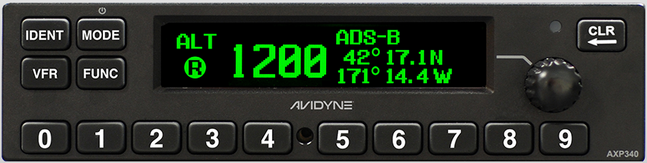
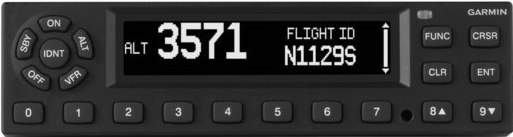
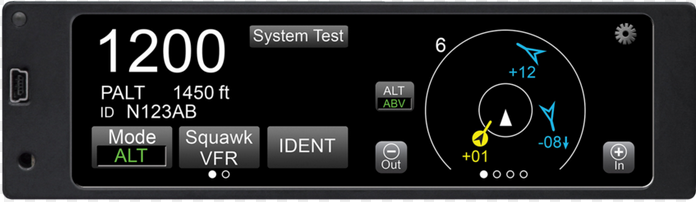
If the aircraft owner is unable to replace the existing transponder with a modern one, for whatever reason, a shadow ADSB-Out product can achieve the same outcome, usually for a significantly lower costs. The most popular product in the market for such purpose is the tailBeacon manufactured by uAvionix.
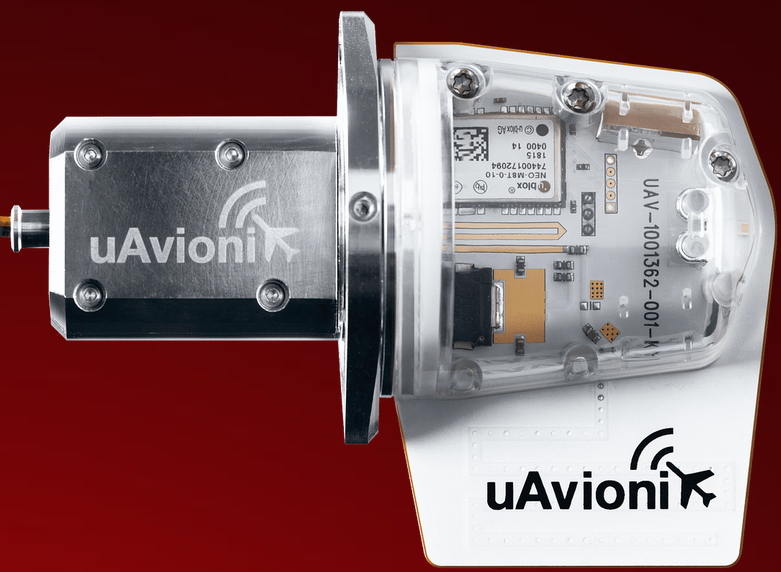
This product is installed as a navigation light, typically replacing the white navigation light located in the tail of the aircraft, and thus powered using the existing power cables. It has a built in antenna, GPS receiver, and a LED light to act as a navigation light. Given it does not have a direct connection to the transponder located in the cockpit, it reads and decodes the non ADSB-Out transponder’s data transmission to learn about the aircraft ID, as well as the squawk code. It then uses that information to generate ADSB-Out data and transmits it via 978 Mhz frequency. The only caveat is that since it is powered by using the same power cable that was used by the tail navigation light, the Nav Light switch in the cockpit must be turned on at all times for ADSB-Out function to operate as intended.
Do All Airplanes Have or Must Have ADSB-Out Capability?
No, not at all. Current regulations regarding ASDB in the U.S. are covered in 14 CFR 91.225 and 14 CFR 91.227. The FAA believes, rightly so, that ADSB-Out capability increases flight safety significantly for all air traffic. This is why, they encouraged, via a government rebate program, general aviation aircraft owners to add this capability to their airplanes. Since this program, many general aviation aircraft got the upgrade however there are still many aircraft fly without ADSB-Out capability in the U.S. That being said, current regulations require an airplane to have ADSB-Out capability to operate in certain air spaces. Following depiction shows where ADSB-Out capability is required by the FAA.
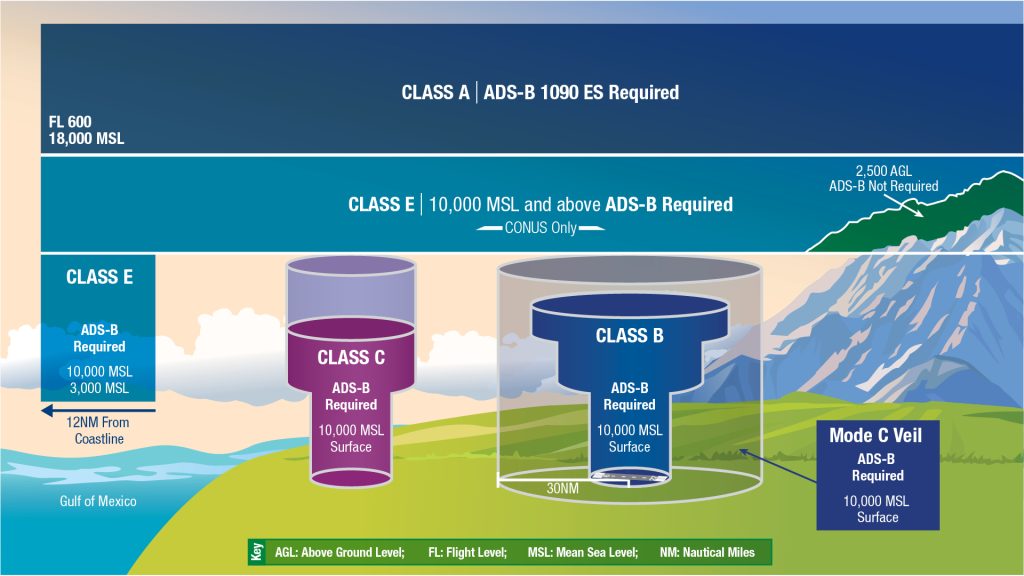
ADSB-In
We discussed how ADSB data is generated and transmitted from aircraft, All that work would be wasteful if we actually don’t receive that data somehow and do something with it. Now, we will discuss how ADSB data traveling in the air can be captured and used for various purposes.
Ground Stations – Receiving Aircraft ADSB Data
United States has deployed 650+ towers all over continental US, Alaska, and Hawaii to receive and use ADSB data broadcasted by airplanes in the sky. As we discussed previously, aircraft flying in the U.S. airspace transmits ADSB data utilizing various systems installed in the aircraft. The data then is received by ground station towers and delivered to the ATC systems. Air Traffic Controllers then can access to all the additional data coming from the aircraft and overlay that on top of the traditional radar view that are used to control airplanes. The additional ADSB data coming from the aircraft provides more situational awareness to the Air Traffic Controllers enabling them to do their jobs better thus leading to a safer airspace for all of us.
Aircraft – Receiving Aircraft ADSB Data

Most modern avionics comes with a built in ADSB receiver. The system can capture ADSB data coming from other aircraft in close proximity, analyze it, and use it to depict traffic on the screen, and provide alerts if you get too close to other aircraft. This significantly increases pilot’s situational awareness when it comes to seeing and avoiding traffic. Relatively new aircraft comes with such avionics and older general aviation aircraft can be upgraded which is typically quite costly. Because of the high cost of avionics upgrades, most pilots flying older general aviation aircraft choose to use a portable ADSB-In device coupled with an iPad running an Electronic Flight Bag Software (EFB) such as Foreflight or Garmin Pilot.
Ground Stations – Transmitting Weather, NOTAMs, and Other Information (FIS-B)
Before we discuss how portable ADSB-In devices work and why using one is a very good idea, we must cover one additional function of ADSB Ground Stations. Before the wonders of ADSB, pilots had very limited information available to them in the air. They could get ATIS information by tuning into ATIS frequencies of nearby airports, ask ATC for weather advisories, or contact Flight Service Station to get detailed weather or NOTAM information. As you can imagine, it was rather difficult to get various information in the cockpit back then. As part of the ADSB deployment, the U.S. funded a program to enable ADSB Ground Stations to transmit (over 978 MHz frequency) very useful weather and airport data. Anyone who has the capability to receive this data can get all the following information free of charge.
| NEXRAD Radar (medium resolution) – CONUS | AIRMETs / SIGMETs | 250 – 500 NM range |
| NEXRAD Radar (low resolution) – 250 NM range | Winds / Temperatures Aloft – 500 NM range |
| METARs, TAFs – 500 NM range | Cloud Tops – Forecast Only |
| NOTAMs – 100 NM range | Lightning – Cloud to Ground Observed |
| TFRs – 100 NM range | Cloud Coverage Satellite Image – Not Available |
| PIREPs – 500 NM range | Coverage – US, Puerto Rico, and Guam |
Portable ADSB-In Devices
There are many brands and types of devices in the market that allow pilots to receive ADSB data generated by other aircraft for traffic depiction purposes, and FIS-B Weather data broadcasted by ADSB Ground Stations. I will cover the most popular ones below.
Stratux Prebuilt (https://amzn.to/4fVywFI) and Stratux Kit (https://amzn.to/3Pt3DgZ)
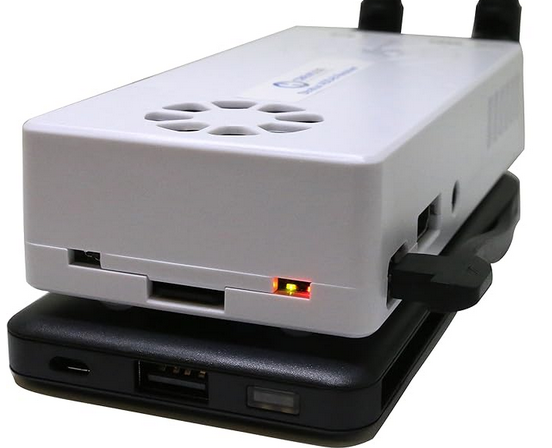
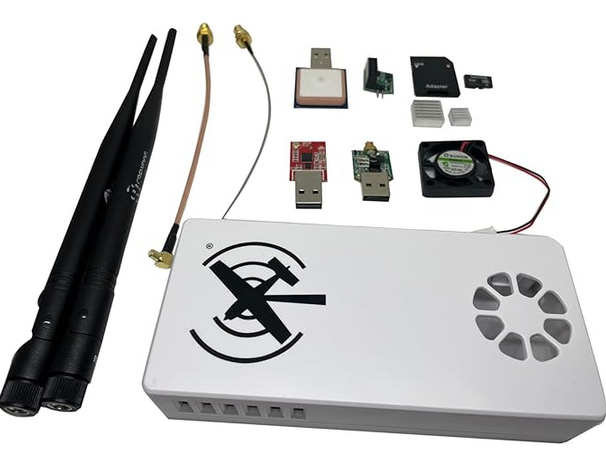
Stratux is a popular low cost – do it yourself – solution that uses an open sourced software. It utilizes a Raspberry Pi board as the main computer which is connected to a radio receiver and GPS module. It is powered by either an external power bank, a USB outlet, or the cigarette lighter located in the cockpit. It is available as a prebuilt, ready to go product, or as a kit for those who are technically savvy and wish to put together the unit themselves. Stratux is not locked into to any EFB software and can be used by many EFBs available to pilots.
Stratus by Appareo
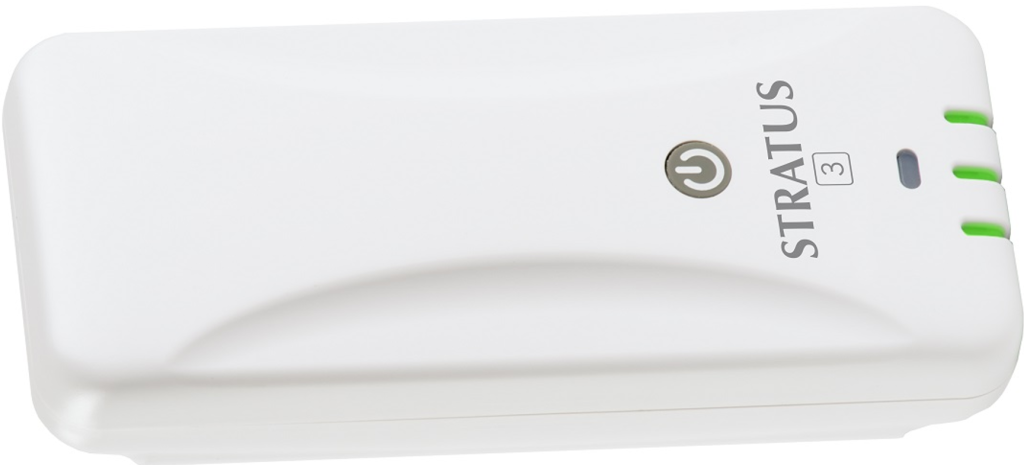
Stratus is one of the higher end ADSB Receiver in the market. It packs pretty much all the same features as Stratux, however, its design is more elegant and it has a smaller form factor. It also has an internal battery hence making it less bulky to carry around. There are two models, Stratus 2 and Stratus 3. The newer model has some additional features, and the most important one is GDL90 support. Stratus 2 only works with Foreflight whereas Stratus 3 will work with any EFBs.
Sentry Mini, Sentry, and Sentry Plus by uAvionix
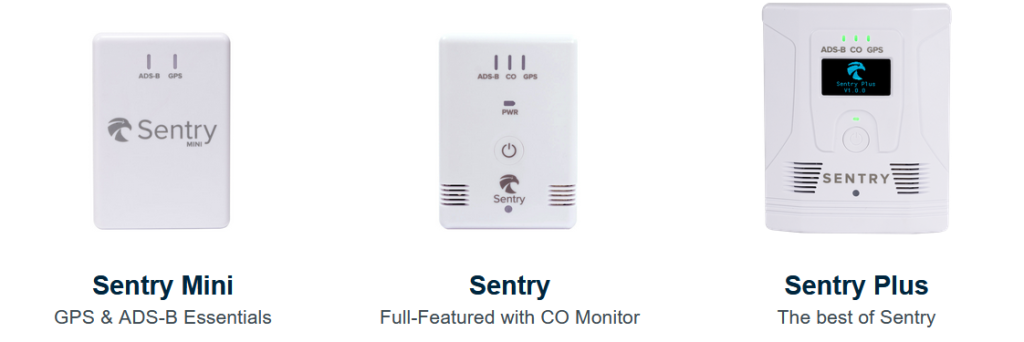
uAvionix manufacture Sentry products exclusively for Foreflight EFB. So if you are using or plan to use any other EFB such as Garmin Pilot, FlyQ, or others, Sentry will not work for you. Currently there are three models available for three different price points. The Mini seems to be popular as an entry product, the middle tier, Sentry, adds higher battery capacity, Carbon Monoxide monitoring, and AHRS for Synthetic Vision (more on this later). Finally the Plus version adds even bigger battery capacity, a display, and some traacklog capabilities. If you chose to go with this product, the middle tier, Sentry model is a good overall receiver.
Garmin GDL 52 – ADSB Meets Satellite SiriusXM Data Feed (https://amzn.to/40cmEtd)

This product is the pinnacle of in cockpit data feeders. It has both ADSB and SiriusXM (satellite) receivers. For most GA pilots, any of the other ADSB receivers will be more than enough to receive traffic, weather, and airport info. However, if you wish to supplement free ADSB data with a subscription based SiriusXM Aviation data, you need a GDL52. You may ask why would I need the additional data from SiriusXM since ADSB provides so much data already. Good question. Feel free to take a look at this comparison chart which shows in detail the differences in data feeds. The biggest differences are high resolution NEXRAD, observed winds aloft and temperatures, storm tracks with windfields, and weather maps. Another difference is that as long as GDL 52 is able to see the sky, you can access all weather products. Comparing that to the ADSB, you must be airborne to receive data from ADSB ground stations. That being said, the catch is that unlike ADSB, SiriusXM is not free and a monthly subscription will cost you a $40 or more depending on the plan you choose.
How to Use the Portable ADSB-In Device
We discussed many portable ADSB devices in the market. Let’s now talk about how we actually use it. It is actually pretty straight forward. Your iPad connects to these devices via Wi-Fi (device acts as a Wi-Fi hot spot) or bluetooth, Once connected to the receiver, the EFB app running on the iPad receives and renders the data coming from the receiver.

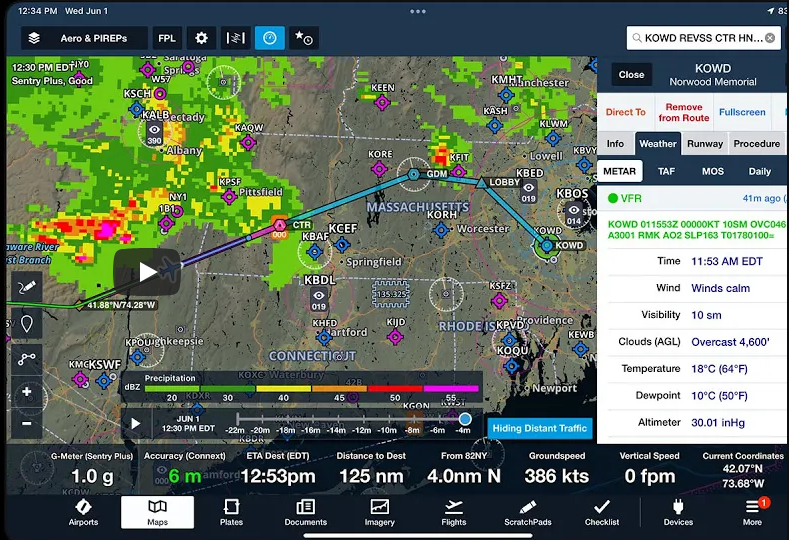
On the left, you can see Foreflight receiving ADSB weather radar data and depicting it on the moving map. Traffic targets received from ADSB would also depicted and color coded in the moving map depending on how far away from your airplane. Different data feeds from ADSB data stream is depicted as map layers and can be individually turned on and off depending on what the pilot wishes to see on the moving map. METARs, TAFs, and NOTAMs are displayed on each airport page, specific to that airport.
As you can see, having access to traffic targets, NOTAMs, TFRs, and a variety of weather information is such an amazing improvement to our cockpits. Our situational awareness in the air vastly improved with these tools which are available rather cost effectively.
What is AHRS and Synthetic Vision?
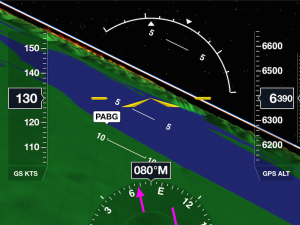
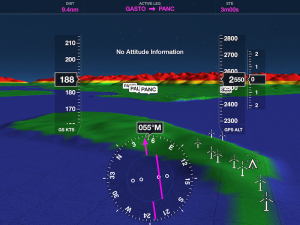
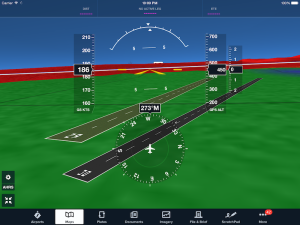
Attitude and Heading Reference System (AHRS) and Synthetic Vision has nothing to do with ADSB at all. However, many portable ADSB receiver devices does include sensors for the AHRS capability. A device with AHRS sensors can detect its orientation in 3D space. Most modern avionics also has this capability already built in. The AHRS sensor in the ADSB receiver device gathers the orientation data and transmits it to the iPad. This data then rendered by the EFB product to generate a Digital Attitude Indicator. This can be extremely useful in an emergency scenario as a backup instrument especially if you fly a six-pack traditional vacuum pump driven instrument panel in your airplane. Synthetic Vision (most right picture above) is another layer of visual that the EFB adds on top of the digital attitude indicator to help pilots with situational awareness. So, if you would like to have the digital attitude indicator feature working in your choice of EFB, the portable ADSB receiver must have AHRS capability built in. Keep that in mind when shopping for a receiver.
That’s it for this blog post. We pretty much covered everything related to ADSB systems that are used in general aviation. Please keep in mind that the information I covered in this post is United States specific. ADSB technology and relevant regulations may be very different in other countries. Finally, you can set up an ADSB receiver cheaply at home to capture ADSB traffic data flying over your house. If you wish to play around with that, see Flightaware ADSB Community Page.
As always, let me know if you have any questions. Happy flying!
P.S. Affiliate links may have been used in this blog post. You may get additional discounts when you use affiliate links.